Globalization of and from China: A state-market-society perspective of the Belt & Road Initiative.

  • Auteur/autrice de la publication :
  • Publication publiée :
  • Catégorie de la publication :

China now seeks to reshape globalisation by projecting its domestic governance model onto the international stage. The Belt and Road Initiative (BRI) perfectly illustrates this dynamic by merging state coordination, market forces, and social embeddedness.

Continuer la lectureGlobalization of and from China: A state-market-society perspective of the Belt & Road Initiative.

Une typologie des stratégies de légitimation d’une innovation. Le cas d’un nouveau SI en santé

  • Auteur/autrice de la publication :
  • Publication publiée :
  • Catégorie de la publication :

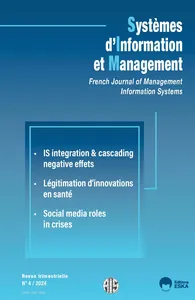
L’objectif de cette recherche est d’identifier les stratégies de légitimation d’un système d’information hospitalier (SI). L’hôpital est un lieu d’innovation pour les SI, mais aussi de remise en question. Leur légitimité dépend des jugements d’un groupe d’évaluateurs individuels ou collectifs. Cette perspective dite evaluator-based, développée par Bitektine (2011), est un complément clé à l’approche dominante de la légitimité (Suchman, 1995). Pour légitimer une innovation, les porteurs de cette innovation doivent convaincre les évaluateurs. Or, les stratégies pour emporter leur conviction sont relativement peu étudiées. D’où notre question de recherche : comment les acteurs qui innovent déploient-ils des stratégies de légitimation de leur innovation en santé ? Pour répondre à cette question, nous avons étudié le cas d’un SI de santé innovant en nous centrant sur les stratégies de légitimation, et en analysant la manière dont elles peuvent modifier les jugements des évaluateurs. Pour cette analyse dynamique et relationnelle, et à des fins méthodologiques, nous avons mobilisé le concept pragmatiste de trans-action. Notre apport théorique réside en une typologie des stratégies de légitimation présentées comme des idéaux-types (Doty et Glick, 1994). Il s’agit d’une typologie explicative au sens de Elman (2005), dans laquelle chaque type est expliqué à l’aide du concept de trans-action.
Continuer la lectureUne typologie des stratégies de légitimation d’une innovation. Le cas d’un nouveau SI en santé

Bridging project management and design thinking: Evidence from digital transformation projects

  • Auteur/autrice de la publication :
  • Publication publiée :
  • Catégorie de la publication :

While recent research calls for renewing project studies, few empirical works explore how design thinking can enrich project management. Based on a longitudinal case study within a company using design thinking to implement digital transformation, we analyze how design thinking supports projects involving major managerial and operational shifts, complex stakeholder environments, and ambiguous objectives. We identify key characteristics of a human-centric project management approach that addressed the difficulties faced by digital transformation and intense change projects, and we show how it helps shaping the projects by focusing on their stakeholders.

Continuer la lectureBridging project management and design thinking: Evidence from digital transformation projects

From Reliability to Pragmatism

  • Auteur/autrice de la publication :
  • Publication publiée :
  • Catégorie de la publication :

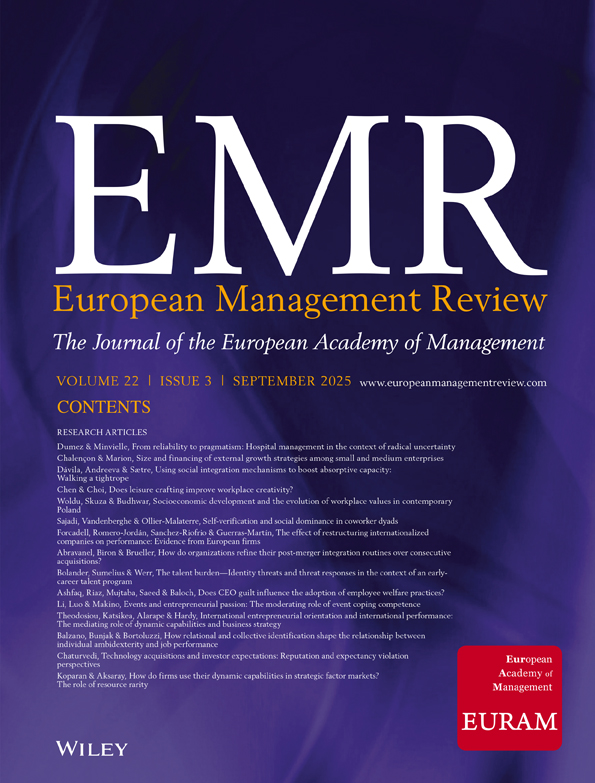
The COVID-19 pandemic presented a scenario of radical uncertainty that hospitals had to manage. Two strands of research can illuminate this management. The first puts forward the high-reliability organization (HRO) principles that the hospital sector has applied for two decades. The second is based on pragmatism and underscores experimental, trial-and-error strategies appropriate for radical uncertainty. This strategy, utilized primarily in the political governance of crises, can be applied in hospital management as well. The results of our qualitative research into French hospitals (109 online interviews over 2020–2021) highlight the importance of pragmatic rationality in crisis management based on organizing collective inquiries. This concept of pragmatic rationality questions the notion of reliability, sticking to pre-existing performance standards not applicable in such contexts. It invites to propose the concept of high pragmatic organization based on five principles that partially integrate those of an HRO.

Continuer la lectureFrom Reliability to Pragmatism

Prison Break From Financialization: The Case of the PRI Reporting and Assessment Framework

  • Auteur/autrice de la publication :
  • Publication publiée :
  • Catégorie de la publication :

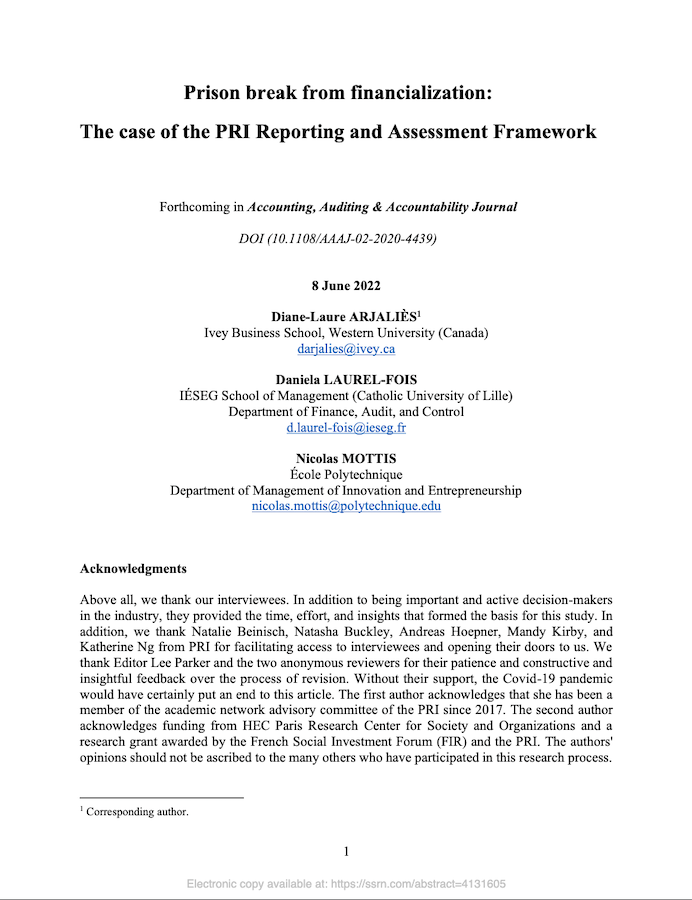
This article seeks to unravel the mechanisms through which financial actors agreed upon a sustainability accounting standard without financializing social and environmental issues, i.e. assigning a monetary value to sustainability.

Continuer la lecturePrison Break From Financialization: The Case of the PRI Reporting and Assessment Framework

Analyse d’une révolution silencieuse: La projectification des entreprises et de la société

  • Auteur/autrice de la publication :
  • Publication publiée :
  • Catégorie de la publication :

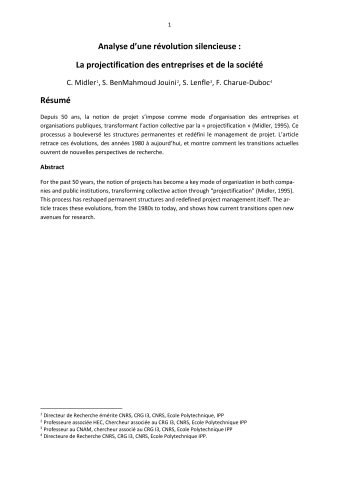
Depuis 50 ans, la notion de projet s’impose comme mode d’organisation des entreprises et organisations publiques, transformant l’action collective par la projectification (Midler, 1995). Ce processus a bouleversé les structures permanentes et redéfini le management de projet. L’article retrace ces évolutions, des années 1980 à aujourd’hui, et montre comment les transitions actuelles ouvrent de nouvelles perspectives de recherche.

Continuer la lectureAnalyse d’une révolution silencieuse: La projectification des entreprises et de la société

The dilemma between fast delivery and deep learning in ecosystem exploration projects: The role of project granularity.

  • Auteur/autrice de la publication :
  • Publication publiée :
  • Catégorie de la publication :

Ecosystem exploration projects, in other words, exploration projects in emerging ecosystems, are vulnerable due to their long-term orientation and multiple uncertainties. These projects face a dilemma: Should the firm prioritize fast delivery of tangible results to maintain stakeholder commitment or deep learning about the exploration domain? Decomposing projects into large modules allocated to stakeholders accelerates delivery and minimizes coordination costs but prevents the focal firm’s learning. Conversely, smaller modules enable that learning but slow down the delivery of tangible outcomes and increase costs. Through an empirical case study, we characterize this dilemma and propose project granularity as a key variable to address it.

Continuer la lectureThe dilemma between fast delivery and deep learning in ecosystem exploration projects: The role of project granularity.

When Saying “Enough” Is Not Enough: How Cultivating Households’ Mindfulness Through Gamification Can Promote Energy Sufficiency

  • Auteur/autrice de la publication :
  • Publication publiée :
  • Catégorie de la publication :

In France, despite the growing importance of public policies to encourage domestic energy sufficiency, there is little understanding of their effectiveness in maintaining households' daily efforts to moderate their use of energy over time. We investigate how gamification instruments can develop households' mindfulness, i.e., the extent of the efforts made (vividness) and their duration in time (stability) to integrate sufficiency practices into their routines. We study the case of a Déclics challenge, a French initiative that aims towards engaging households with energy reduction plans through gamification. Our empirical material comprises 18 interviews with participants in the Déclics challenge covering towns in the eastern Paris region, a 1-year participant observation, and complementary interviews and meetings with organizers. Our findings reveal mixed effects of the challenge according to the different household profiles identified in terms of the vividness of their practices before, during and after the challenge and their responses to the challenge's gamification instruments. Our study shows that policymakers should invest further in designing interventions that reduce the efforts required from individuals to integrate sufficiency into their routines.

Continuer la lectureWhen Saying “Enough” Is Not Enough: How Cultivating Households’ Mindfulness Through Gamification Can Promote Energy Sufficiency

Ange ou démon?-Représentations sociales de l’IA chez les professionnels du secteur des services

  • Auteur/autrice de la publication :
  • Publication publiée :
  • Catégorie de la publication :

Cette recherche explore les représentations sociales de l’intelligence artificielle (IA) dans les services en France, grâce à la théorie du noyau central et au concept d’implication personnelle. Cent cinquante professionnels ont été interrogés en recourant à la méthode d’association libre. Les résultats révèlent des perceptions contrastées selon le degré d’implication en IA et des valences attitudinales parfois opposées. Les plus impliqués mobilisent une rationalité instrumentale, axée sur les fonctionnalités de l’IA et la projetant dans un futur stratégique. Les moins impliqués expriment une rationalité sociale, marquée par des éléments normatifs et une temporalité réactive centrée sur des gains d’efficacité immédiats. Cette divergence redéfinit l’enjeu managérial, qui ne consiste plus à mieux intégrer l’IA en surmontant la résistance, mais bien à arbitrer les rationalités pour décider souverainement et collectivement de la pertinence de l’outil.

Continuer la lectureAnge ou démon?-Représentations sociales de l’IA chez les professionnels du secteur des services