Représenter pour enquêter : une analyse des outils empiriques d’ateliers d’enquêtes en Sciences sociales

  • Auteur/autrice de la publication :
  • Publication publiée :
  • Catégorie de la publication :

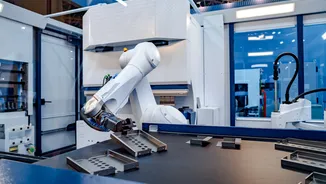
La pratique du design, et des disciplines de la conception en général, repose sur la production de représentations comme forme d’externalisation de la pensée (Visser, 2006), et sur l’enquête comme moyen empirique de compréhension des enjeux des parties prenantes d’un projet. Cet article s’inscrit à l’intersection de ces deux éléments, en posant la question de la pratique représentationnelle pour l’enquête : comment des designers-chercheurs débutants mobilisent-ils leurs compétences d’expression graphique pour développer des dispositifs d’enquête originaux afin de comprendre les comportements, les expériences et les opinions des enquêtés. L’article présente un retour d’expérience de 4 éditions d’un atelier de recherche en sciences sociales pour le design, dans le cadre d’une formation à la recherche. Chacun des dispositifs d’enquête construits pas les 25 groupes d’étudiants est caractérisé sur différentes variables relatives aux modes de collecte de donnée, aux types de données récoltées, à leur traitement et leur usage. Nous concluons sur les enjeux liés à l’articulation d’approches sensibles et analytiques dans les enquêtes de sciences sociales dans le champ de la recherche en Design.


Continuer la lectureReprésenter pour enquêter : une analyse des outils empiriques d’ateliers d’enquêtes en Sciences sociales

Prendre en charge les inégalités environnementales

  • Auteur/autrice de la publication :
  • Publication publiée :
  • Catégorie de la publication :

À partir d’une méthodologie à la fois qualitative et quantitative, et partant de l’échantillonnage de quatre territoires urbains (Paris 18e, Ivry-sur-Seine, Aubervilliers, Clamart) en fonction des inégalités observées, cet article se donne comme objectif d’étudier l’évolution des relations entre les collectivités locales et les associations et collectifs dans un contexte de transition socio-environnementale intégrant les enjeux de justice. Ces collectifs associatifs ont pour point commun d’aborder de façon conjointe les questions environnementales et sociales via leurs répertoires d’action : le spectre s’étend de la recyclerie de quartier à l’épicerie solidaire en passant par le jardin partagé impliqué dans de l’éducation populaire. La démarche comparative entre les quatre territoires analyse les spécificités des mobilisations des associations et collectifs au regard des inégalités socio-environnementales dans chaque commune.

Continuer la lecturePrendre en charge les inégalités environnementales

Des chemins pour une adaptation transformationnelle des territoires du Grand Paris

  • Auteur/autrice de la publication :
  • Publication publiée :
  • Catégorie de la publication :

Les pratiques et représentations de l’adaptation au changement climatique sont transformées, ces dernières années, en réponse à l’urgence écologique grandissante. Toutefois, notre recherche enseigne que l’adaptation conçue dans les projets urbains du Grand Paris est le plus souvent envisagée sous un angle d’adaptation fonctionnelle des interfaces entre le végétal, l’eau et les sols, sans tirer parti des initiatives de transition menées dans ces territoires. La capacité transformatrice des acteurs locaux sur les chemins de transition socioécologique et démocratique à l’échelle locale s’en trouve amenuisée. Or, cette seconde signification donnée au terme d’adaptation envisagée comme adaptation « transformationnelle », conjuguant des bifurcations dans les interactions avec les milieux et les relations entre collectivités et citoyens, acquiert une place plus importante dans les recherches académiques et les mouvements professionnels et sociaux qui militent en faveur d’une adaptation plus structurelle des sociétés aux changements climatiques.

Continuer la lectureDes chemins pour une adaptation transformationnelle des territoires du Grand Paris

Should robots display what they hear? Mishearing as a practical accomplishment.

  • Auteur/autrice de la publication :
  • Publication publiée :
  • Catégorie de la publication :

As a contribution to research on transparency and failures in human–robot interaction (HRI), our study investigates whether the informational ecology configured by publicly displaying a robot’s automatic speech recognition (ASR) results is consequential in how miscommunications emerge and are dealt with. After a preliminary quantitative analysis of our participants’ gaze behavior during an experiment where they interacted with a conversational robot, we rely on a micro-analytic approach to detail how the interpretation of this robot’s conduct as inadequate was configured by what it displayed as having “heard” on its tablet. We investigate cases where an utterance or gesture by the robot was treated by participants as sequentially relevant only as long as they had not read the automatic speech recognition transcript but re-evaluated it as troublesome once they had read it. In doing so, we contribute to HRI by showing that systematically displaying an ASR transcript can play a crucial role in participants’ interpretation of a co-constructed action (such as shaking hands with a robot) as having “failed”. We demonstrate that “mistakes” and “errors” can be approached as practical accomplishments that emerge as such over the course of interaction rather than as social or technical phenomena pre-categorized by the researcher in reference to criteria exogenous to the activity being analyzed. In the end, while narrowing down on two video fragments, we find that this peculiar informational ecology did not merely impact how the robot was responded to. Instead, it modified the very definition of “mutual understanding” that was enacted and oriented to as relevant by the human participants in these fragments. Besides social robots, we caution that systematically providing such transcripts is a design decision not to be taken lightly; depending on the setting, it may have unintended consequences on interactions between humans and any form of conversational interface.

Continuer la lectureShould robots display what they hear? Mishearing as a practical accomplishment.

Personal noticings in video calls and doing being friends

  • Auteur/autrice de la publication :
  • Publication publiée :
  • Catégorie de la publication :

In this article, I focus on an interactional practice, personal noticings', in which a participant comments on something related to another's appearance, behavior, or environment. From the perspective of conversation analysis, I discuss the organization of these sequences and show how they put into play relational issues between participants. I then show that the affordances of video-mediated communication facilitate the production of personal noticings and analyze various examples of personal noticings made during video-mediated conversations between friends, as well as the relational work accomplished during these sequences. The case of personal noticings in video-mediated conversations illustrates how it is possible to precisely study the dynamics between interpersonal relationships and mediated forms of sociability at the level of the interactional practices themselves.

Continuer la lecturePersonal noticings in video calls and doing being friends

Digital “overconnectivity” at work: a qualitative and quantitative study.

  • Auteur/autrice de la publication :
  • Publication publiée :
  • Catégorie de la publication :

The rise of communication technologies and their intensive use in the workplace, in conjunction with the 2016 French labor law’s “right to disconnect”, has resulted in peaked interest in occupational risk prevention. This qualitative and quantitative study aims to define digital “overconnectivity”, the causes of discomfort experienced by employees while connected, and the connection regulation strategies within the enterprise. The aim is to take targeted preventive actions based on the results. The activity and lived experience of digital connection is studied through a questionnaire and through interviews, with a population of executives at the company Orange. Sources of discomfort associated with digital connectivity are identified and regulations in the company are analyzed.

Continuer la lectureDigital “overconnectivity” at work: a qualitative and quantitative study.

Abandoning the Car to Embrace the Bicycle in Urban France: A Model of Modal Shift for Daily Commuting Routines. Sustainability

  • Auteur/autrice de la publication :
  • Publication publiée :
  • Catégorie de la publication :

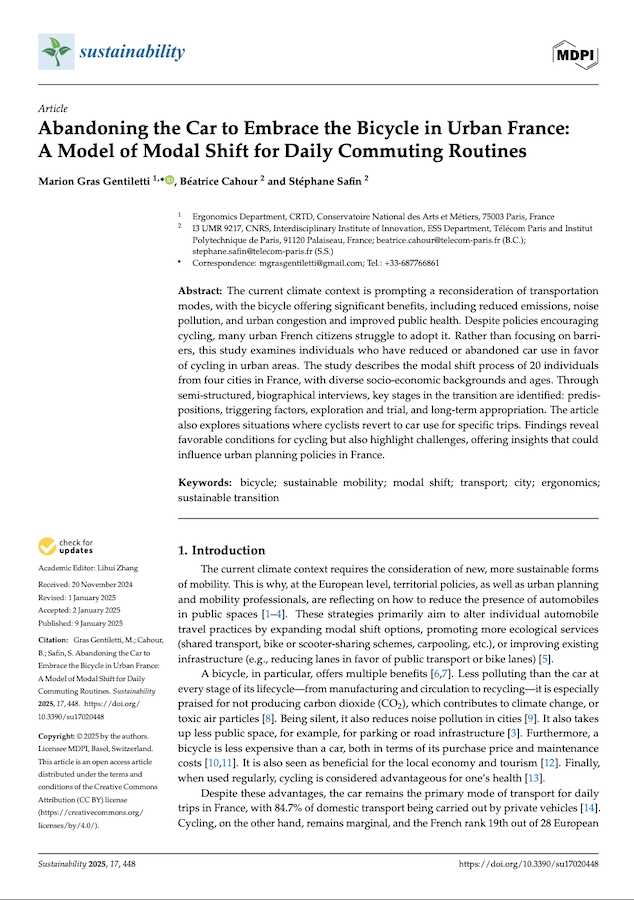
The current climate context is prompting a reconsideration of transportation modes, with the bicycle offering significant benefits, including reduced emissions, noise pollution, and urban congestion and improved public health. Despite policies encouraging cycling, many urban French citizens struggle to adopt it. Rather than focusing on barriers, this study examines individuals who have reduced or abandoned car use in favor of cycling in urban areas. The study describes the modal shift process of 20 individuals from four cities in France, with diverse socio-economic backgrounds and ages. Through semi-structured, biographical interviews, key stages in the transition are identified: predispositions, triggering factors, exploration and trial, and long-term appropriation. The article also explores situations where cyclists revert to car use for specific trips. Findings reveal favorable conditions for cycling but also highlight challenges, offering insights that could influence urban planning policies in France.

Continuer la lectureAbandoning the Car to Embrace the Bicycle in Urban France: A Model of Modal Shift for Daily Commuting Routines. Sustainability

Oncogene-driven advocacy : Collective expertise and therapeutic actionability.

  • Auteur/autrice de la publication :
  • Publication publiée :
  • Catégorie de la publication :

This paper is intended as a contribution to the social science literature on Patient Advocacy Groups (PAGs). It examines the recent emergence and development of cancer patient organizations that self-define as “oncogene-focused,” that is, as centered on tumor-driving genetic mutations that offer novel therapeutic opportunities for tumors to be targeted by precision drugs. Drawing on qualitative methods including interviews with representatives of oncogene focused PAGs, analysis of the groups’ publications (biomedical journals, eNewsletters), websites, and social media activity, the paper explores the characteristics of these PAGs’ forms of activism. It shows that their common denominator is a focus on patient survival. This shared goal translates into a form of activism that centers on therapeutic actionability, that is, a set of initiatives aiming at the articulation of research, clinical trials, and care to improve the patients’ quality of life and maximize survival thanks to awareness of and access to the latest therapies. Beyond individual differences between PAGs, we observe the increasingly seamless entanglement of their activities. Their mutually supportive interventions result in the establishment of an ecosystemic form of activism that also succeeds in mobilizing clinicians and researchers at the increasingly porous interface between research and care.

Continuer la lectureOncogene-driven advocacy : Collective expertise and therapeutic actionability.

Reproblematising maintenance, reconsidering infrastructures: The emergence of a more-than-corrective maintenance programme in French water networks management

  • Auteur/autrice de la publication :
  • Publication publiée :
  • Catégorie de la publication :

In an increasing number of countries, mainly but not restrictively in the global North, the combination of infrastructures’ degradation, budgetary constraints and rising environmental issues has gradually shifted professional and public concerns from extension to upkeep. This constitutes the crystallisation of a specific configuration of infrastructure management, which the authors propose to term an “age of infrastructure maintenance” and which contrasts dramatically with the modern infrastructural ideal. Focussing on French water network management, this paper draws on an 18-month in-depth institutional ethnography to investigate what this age of maintenance concretely encompasses. It shows that in France, and in Europe, such an age rests on a reproblematisation of maintenance, whose scope is reframed in a “more-than-corrective” perspective. This leads to a practical and ontological reconsideration of infrastructures, which is illustrated by three main transformations: infrastructures are rediscovered through proximal enquiries, they are carefully monitored as living entities, and they are put at the centre of new valuation processes. This specific moment of infrastructure maintenance appears to be generative, opening up multifaceted transformations that pave the way for a less modernist and industrial vision of infrastructure management.

Continuer la lectureReproblematising maintenance, reconsidering infrastructures: The emergence of a more-than-corrective maintenance programme in French water networks management

The Endless Repetition of Graffiti Writing and Removing: Gestures, Sites, Traces

  • Auteur/autrice de la publication :
  • Publication publiée :
  • Catégorie de la publication :

Although graffiti writing has been the object of numerous analyses for fifty years, the entangled practices of graffiti writers and buffers’ interventions remain understudied. By considering their actual gestures in front of urban surfaces, this text emphasizes the similarities of practices usually seen as antagonistic. Drawing on Deleuze’s masterful work about repetition and difference, it notably points out the sensitive, attentional, and technical common features of graffiti writers and buffers, the choreographic dynamics at the core of their performances, and the layered material rhythm resulting from their intertwined actions. Whether they take the form of a soothed dialogue moved by a shared experience, a trench warfare in performances, or an intense unintended collaboration, the relationships between graffiti writers and buffers appear to be driven by the transformative principle of repetition.

Continuer la lectureThe Endless Repetition of Graffiti Writing and Removing: Gestures, Sites, Traces