
Singularization/Mutualization: The emergence of a new form of patient activism around biomedical entities.

  • Auteur/autrice de la publication :
  • Publication publiée :
  • Catégorie de la publication :

This chapter extends the STS perspective on the involvement of patient organizations in biomedical research to organizations named after the infra-molecular entities driving their diseases: rare genetic disease and oncogene-focused patient groups. From what perspective do these novel kinds of associations rally around molecular entities and their affordances? Is the reference to these entities associated with specific modalities of action especially as regards basic and clinical research and therapy? We show that the grouping of patients around such entities amounts to a dual process of singularization/mutualization. Singularization processes parallel the disassembling and reassembling of nosological categories engendered by genomic investigations. However, singularizing is associated with mutualizing: by comparing disease singularities and their differential effects, patient associations identify shared problems or overlaps with regards to diagnostic practices and therapeutic interventions. The transformative effects of the singularizing and mutualizing processes make them a key component of the biomedicine and society research agenda.

Continuer la lectureSingularization/Mutualization: The emergence of a new form of patient activism around biomedical entities.

La résilience organisationnelle face à l’intelligence artificielle : Examen critique du concept de human in the loop en action

  • Auteur/autrice de la publication :
  • Publication publiée :
  • Catégorie de la publication :

Le concept de human in the loop (HITL, « humain dans la boucle ») est considéré comme clé pour la résilience des organisations déployant des Intelligences Artificielles (IA). Pourtant, une part croissante de la littérature souligne l’urgence d’en évaluer la pertinence pratique et les limites. Nous y contribuons en nous appuyant sur deux études de cas : un accident mortel provoqué par une voiture autonome et le flash crash boursier de mai 2010 alimenté par le trading à haute fréquence. Nos résultats soulignent plusieurs limites du dispositif HITL. Dans les deux cas, il échoue à encourager les humains à adopter une position de vigilance complémentaire aux capacités calculatoires de la machine. En discussion avec la littérature sur la résilience organisationnelle, nous formulons plusieurs recommandations, notamment la nécessaire introduction d’une formalisation du doute dans l’interfaçage homme-machine.

Continuer la lectureLa résilience organisationnelle face à l’intelligence artificielle : Examen critique du concept de human in the loop en action

Les enjeux économiques, politiques et managériaux de l’innovation responsable

  • Auteur/autrice de la publication :
  • Publication publiée :
  • Catégorie de la publication :

Cet article introductif présente (i) la définition et l’historique de l’innovation responsable (IR), (ii) les enjeux managériaux de l’IR, (iii) les enjeux en matière de politiques de soutien à l’innovation et (iv) les principaux défis que pose le concept d’IR pour la recherche en économie et gestion de l’innovation.

Continuer la lectureLes enjeux économiques, politiques et managériaux de l’innovation responsable

Les actionnaires responsables, minoritaires mais influents ? Étude de l’engagement actionnarial chez TotalEnergies.

  • Auteur/autrice de la publication :
  • Publication publiée :
  • Catégorie de la publication :

Dans le contexte des grands challenges auxquels nous faisons face, certains actionnaires poussent les entreprises à adopter des stratégies de durabilité (ou « ESG ») robustes, notamment via l’engagement actionnarial. Cet article explore ces pratiques et leur effet à travers le cas de coalitions d’investisseurs engageant TotalEnergies SE (major pétrolière française). Les auteurs montrent comment ces actionnaires minoritaires peuvent influencer significativement les stratégies de durabilité des entreprises en catalysant la pression externe exercée par leurs parties prenantes, grâce à des mécanismes de collaboration précis permettant d’éviter les ingérences et pressions des dirigeants. Le « succès » ambigu de ces démarches doit être analysé à la lumière de l’impact sociétal à long terme de la société ciblée. Cette ambiguïté ne doit donc pas éclipser le rôle du régulateur dans la transition durable.

Continuer la lectureLes actionnaires responsables, minoritaires mais influents ? Étude de l’engagement actionnarial chez TotalEnergies.

‘I’d give my right arm to be ambidextrous’: Exploration unit managers facing competing demands for differentiation and integration.

  • Auteur/autrice de la publication :
  • Publication publiée :
  • Catégorie de la publication :

This paper examines how innovation lab managers balance differentiation and integration over time through a longitudinal study of four units. The study identifies two undocumented paradoxical tensions and four response patterns—decoupling, conforming, promoting, and synchronizing—to enhance the practical understanding of structural ambidexterity.

Continuer la lecture‘I’d give my right arm to be ambidextrous’: Exploration unit managers facing competing demands for differentiation and integration.

Where to Start? Exploring How Sustainable Startups Integrate Sustainability Impact Assessment Within Their Entrepreneurial Process

  • Auteur/autrice de la publication :
  • Publication publiée :
  • Catégorie de la publication :

While startups are acknowledged for their potential to address sustainability issues, little is known on how to assess their impact, given the uncertainty they deal with and their lack of resources. This paper investigates the ones that are supposed to be ‘best-in-class’ in that matter, that is, startups targeting sustainability, in order to explore how they integrate sustainability impact assessment in their entrepreneurial process. We conducted a multiple case study of eight sustainable startups, based on a 2-year longitudinal research in their incubator to gather multiple sources of information. Our results revealed that the integration of the triple bottom line in the entrepreneurial process has a major effect on startups’ sustainability impact assessment practices. ‘Born-sustainable startups’, which have aimed for the triple bottom line since idea generation, have more robust tools and routines than ‘Transitioned sustainable startups’, which integrated the triple bottom line during prototype/validation.

Continuer la lectureWhere to Start? Exploring How Sustainable Startups Integrate Sustainability Impact Assessment Within Their Entrepreneurial Process

Globalization of and from China: A state-market-society perspective of the Belt & Road Initiative.

  • Auteur/autrice de la publication :
  • Publication publiée :
  • Catégorie de la publication :

China now seeks to reshape globalisation by projecting its domestic governance model onto the international stage. The Belt and Road Initiative (BRI) perfectly illustrates this dynamic by merging state coordination, market forces, and social embeddedness.

Continuer la lectureGlobalization of and from China: A state-market-society perspective of the Belt & Road Initiative.

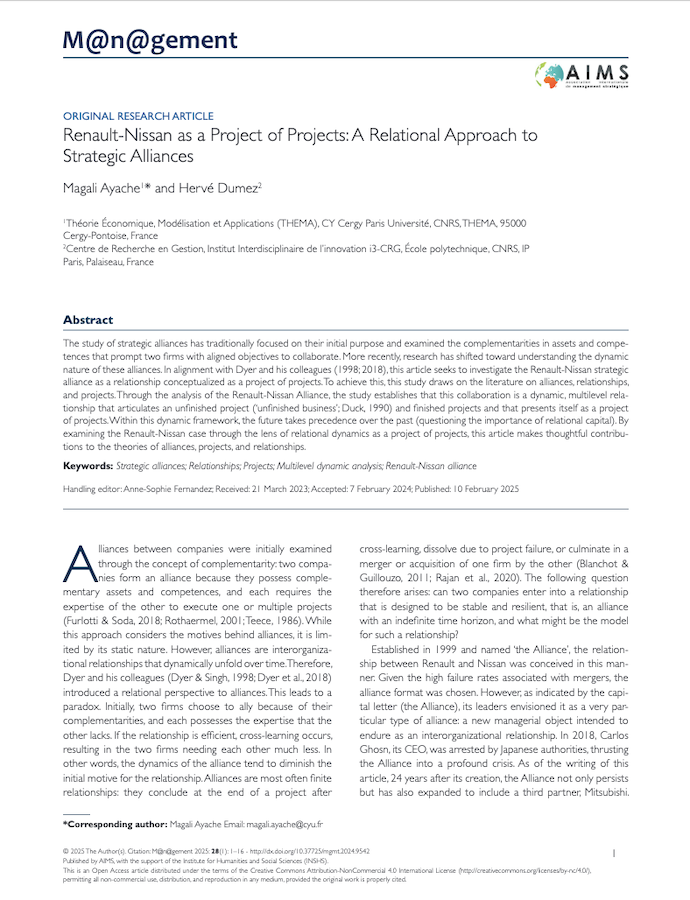
Renault-Nissan as a project of projects

  • Auteur/autrice de la publication :
  • Publication publiée :
  • Catégorie de la publication :

The study of strategic alliances has traditionally focused on their initial purpose and examined the complementarities in assets and competences that prompt two firms with aligned objectives to collaborate. More recently, research has shifted toward understanding the dynamic nature of these alliances. In alignment with Dyer and his colleagues (1998; 2018), this article seeks to investigate the Renault-Nissan strategic alliance as a relationship conceptualized as a project of projects. To achieve this, this study draws on the literature on alliances, relationships, and projects. Through the analysis of the Renault-Nissan Alliance, the study establishes that this collaboration is a dynamic, multilevel relationship that articulates an unfinished project (‘unfinished business’; Duck, 1990) and finished projects and that presents itself as a project of projects. Within this dynamic framework, the future takes precedence over the past (questioning the importance of relational capital). By examining the Renault-Nissan case through the lens of relational dynamics as a project of projects, this article makes thoughtful contributions to the theories of alliances, projects, and relationships.

Continuer la lectureRenault-Nissan as a project of projects

Une typologie des stratégies de légitimation d’une innovation. Le cas d’un nouveau SI en santé

  • Auteur/autrice de la publication :
  • Publication publiée :
  • Catégorie de la publication :

L’objectif de cette recherche est d’identifier les stratégies de légitimation d’un système d’information hospitalier (SI). L’hôpital est un lieu d’innovation pour les SI, mais aussi de remise en question. Leur légitimité dépend des jugements d’un groupe d’évaluateurs individuels ou collectifs. Cette perspective dite evaluator-based, développée par Bitektine (2011), est un complément clé à l’approche dominante de la légitimité (Suchman, 1995). Pour légitimer une innovation, les porteurs de cette innovation doivent convaincre les évaluateurs. Or, les stratégies pour emporter leur conviction sont relativement peu étudiées. D’où notre question de recherche : comment les acteurs qui innovent déploient-ils des stratégies de légitimation de leur innovation en santé ? Pour répondre à cette question, nous avons étudié le cas d’un SI de santé innovant en nous centrant sur les stratégies de légitimation, et en analysant la manière dont elles peuvent modifier les jugements des évaluateurs. Pour cette analyse dynamique et relationnelle, et à des fins méthodologiques, nous avons mobilisé le concept pragmatiste de trans-action. Notre apport théorique réside en une typologie des stratégies de légitimation présentées comme des idéaux-types (Doty et Glick, 1994). Il s’agit d’une typologie explicative au sens de Elman (2005), dans laquelle chaque type est expliqué à l’aide du concept de trans-action.

Continuer la lectureUne typologie des stratégies de légitimation d’une innovation. Le cas d’un nouveau SI en santé

Bridging project management and design thinking: Evidence from digital transformation projects

  • Auteur/autrice de la publication :
  • Publication publiée :
  • Catégorie de la publication :

While recent research calls for renewing project studies, few empirical works explore how design thinking can enrich project management. Based on a longitudinal case study within a company using design thinking to implement digital transformation, we analyze how design thinking supports projects involving major managerial and operational shifts, complex stakeholder environments, and ambiguous objectives. We identify key characteristics of a human-centric project management approach that addressed the difficulties faced by digital transformation and intense change projects, and we show how it helps shaping the projects by focusing on their stakeholders.

Continuer la lectureBridging project management and design thinking: Evidence from digital transformation projects