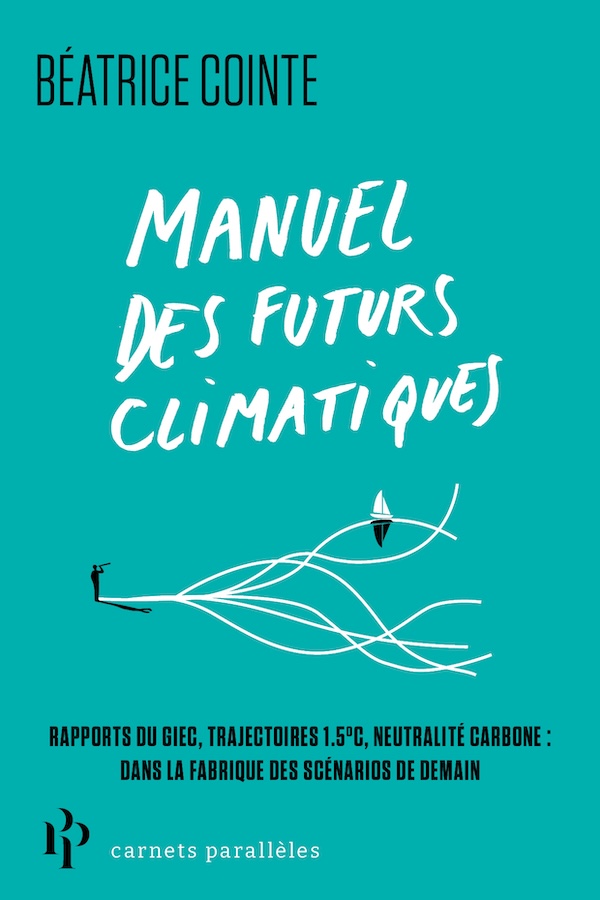
Manuel des futurs climatiques. Rapports du GIEC, trajectoires 1,5°C, neutralité carbone : dans la fabrique des scénarios de demain

  • Auteur/autrice de la publication :
  • Publication publiée :
  • Catégorie de la publication :

Cela fait près d’un demi-siècle que l’action climatique se conjugue au futur. Ce sujet, plus qu’aucun autre, rappelle que le futur est politique, et donc discutable. Le problème, c’est que les futurs climatiques s’écrivent et se discutent dans un langage souvent impénétrable, sur lequel nous n’avons pas prise. Scénarios du GIEC, trajectoires 1.5°C, transition énergétique, overshoot… autant de termes omniprésents dès qu’il est question de climat, mais qu’on n’est guère équipés pour comprendre. Ce livre les raconte en se plaçant à une échelle humaine : en suivant celles et ceux qui travaillent avec au quotidien et en décortiquant les outils qu’ils utilisent pour le faire. Il décrit les infrastructures qui soutiennent leur travail et rend compte de leurs questionnements, de leurs désaccords et de leurs désarrois – qui sont aussi les nôtres. Découpé en une série d’entrées qui se penchent sur les modèles informatiques, les infrastructures de recherche et les objets des sciences de l’atténuation du changement climatique, ce petit livre est un guide de lecture des scénarios climatiques. Écrites de manière vivante et incarnée, elles permettent aux lecteurs de comprendre comment la communauté scientifique s’organise pour faire face au défi climatique.

Continuer la lectureManuel des futurs climatiques. Rapports du GIEC, trajectoires 1,5°C, neutralité carbone : dans la fabrique des scénarios de demain

Frictions sous-marines. Écologies et politiques des fragilités de l’interconnexion numérique.

  • Auteur/autrice de la publication :
  • Publication publiée :
  • Catégorie de la publication :

Dans cet article, nous nous intéressons aux frictions qui ont accompagné l’atterrissage du câble PEACE MED (Pakistan and East Africa Connecting Europe - Mediterranean section) en 2021 à Marseille. Plutôt que d’exclure le câble des zones de protection de la nature, les études d’incidence ont conseillé de les traverser, mettant en avant la possibilité d’une cohabitation harmonieuse entre l’infrastructure et la biodiversité sous-marine, ainsi que les risques encourus par le câble à s’avancer en d’autres eaux. Cette association inattendue entre câbles et herbiers affaiblit la position de deux acteurs qui souhaitent changer la route traditionnelle empruntée par les câbles. Le Parc National des Calanques d’abord, qui au nom d’une séparation stricte des activités anthropiques et des milieux naturels protégés, souhaiterait voir les câbles s’éloigner des espaces dont il a la responsabilité. Le Grand Port Maritime de Marseille ensuite, qui, après avoir investi des millions d’euros dans une infrastructure capable d’accueillir des câbles sous-marins, n’est pas parvenu à attirer PEACE MED dans son enceinte.

Continuer la lectureFrictions sous-marines. Écologies et politiques des fragilités de l’interconnexion numérique.

What makes minerals critical? Problematizing sovereignty in times of crisis.

  • Auteur/autrice de la publication :
  • Publication publiée :
  • Catégorie de la publication :

This paper examines what makes minerals "critical" by analyzing criticality studies, which are geological and economic analyses aimed at forecasting future supply risks. It explores three contemporary examples from European and French contexts. In Europe, critical materials are discussed in relation to the recent Critical Raw Materials Act. While the European approach highlights a crisis in Europe’s capacity to monitor and respond to market trends, the French cases present different ways of framing the crisis. One case, involving the institution Ofremi, focuses on outlining strategic directions to safeguard national sovereignty and prepare for external threats to the economy. The other stems from a state-owned electricity distribution company, which uses criticality as a framework for exploring the technical and political choices that shape energy transition trajectories. The analysis of these three cases demonstrates that defining criticality ultimately reflects the desired expressions of sovereignty in times of crisis. More than just a technical assessment of supply risks, criticality embodies deeper struggles over how states define crises and assert sovereignty.

Continuer la lectureWhat makes minerals critical? Problematizing sovereignty in times of crisis.

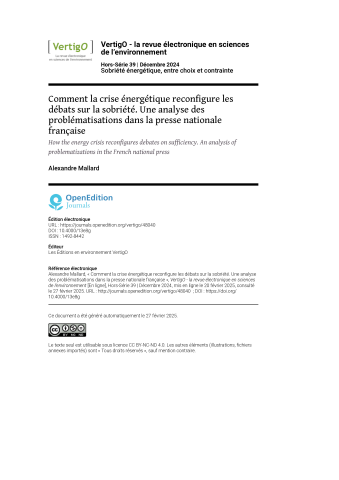
Comment la crise énergétique reconfigure les débats sur la sobriété. Une analyse des problématisations dans la presse nationale française

  • Auteur/autrice de la publication :
  • Publication publiée :
  • Catégorie de la publication :

Cet article étudie les débats dans la presse nationale française autour de la notion de sobriété énergétique au cours des 15 dernières années. À partir d’une analyse mobilisant l’outil CorText, il suit la manière dont la notion de sobriété a fait l’objet de problématisations successives durant la période 2009-2021, et il examine les transformations qui se sont opérées avec la crise énergétique de 2022. Il met ainsi en évidence les formes de politisation qui se déploient autour de l’envolée des prix des énergies et des risques de ruptures de l’approvisionnement énergétique, ainsi que des formes de gouvernement de la sobriété déployées en 2022. Il questionne enfin les figures de la sobriété comme objet de discussion politique et morale ou comme composante des trajectoires des innovations pour l’énergie et le climat telles qu’elles apparaissent dans la presse.

Continuer la lectureComment la crise énergétique reconfigure les débats sur la sobriété. Une analyse des problématisations dans la presse nationale française

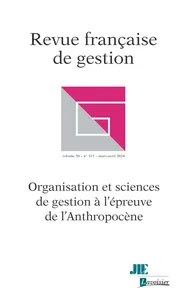
Management de l’innovation, Anthropocène et transition écologique. L’impasse du naturalisme

  • Auteur/autrice de la publication :
  • Publication publiée :
  • Catégorie de la publication :

Le présent essai se propose de revisiter le management de l’innovation à la lumière des travaux de l’anthropologue Philippe Descola. Il montre comment l’ontologie naturaliste typique de nos sociétés occidentales, qui instaure une séparation claire entre nature et culture, trouve sa traduction dans le concept schumpetérien de destruction créatrice. L’analyse montre ensuite comment ce cadre général se traduit dans le champ du management de l’innovation par un biais pro-innovation qui rejette de facto la question des fins du processus et des limites écologiques hors du champ de l’analyse, ce qui constitue un obstacle ontologique pour penser la transition écologique. Les évolutions en cours sont par la suite discutées et quelques perspectives de recherche tracées.

Continuer la lectureManagement de l’innovation, Anthropocène et transition écologique. L’impasse du naturalisme

When Saying “Enough” Is Not Enough: How Cultivating Households’ Mindfulness Through Gamification Can Promote Energy Sufficiency

  • Auteur/autrice de la publication :
  • Publication publiée :
  • Catégorie de la publication :

In France, despite the growing importance of public policies to encourage domestic energy sufficiency, there is little understanding of their effectiveness in maintaining households' daily efforts to moderate their use of energy over time. We investigate how gamification instruments can develop households' mindfulness, i.e., the extent of the efforts made (vividness) and their duration in time (stability) to integrate sufficiency practices into their routines. We study the case of a Déclics challenge, a French initiative that aims towards engaging households with energy reduction plans through gamification. Our empirical material comprises 18 interviews with participants in the Déclics challenge covering towns in the eastern Paris region, a 1-year participant observation, and complementary interviews and meetings with organizers. Our findings reveal mixed effects of the challenge according to the different household profiles identified in terms of the vividness of their practices before, during and after the challenge and their responses to the challenge's gamification instruments. Our study shows that policymakers should invest further in designing interventions that reduce the efforts required from individuals to integrate sufficiency into their routines.

Continuer la lectureWhen Saying “Enough” Is Not Enough: How Cultivating Households’ Mindfulness Through Gamification Can Promote Energy Sufficiency

Federated digital twins platform for smart city logistics: A knowledge-driven approach

  • Auteur/autrice de la publication :
  • Publication publiée :
  • Catégorie de la publication :

Urban logistics faces increasing pressure from rising population densities, escalating delivery demands, and constrained urban resources. Traditional logistics systems struggle to adapt to real-time urban dynamics, leading to inefficiencies, congestion, and environmental concerns. A key challenge lies in mobilizing underutilized assets, such as off-hour freight parking, and adopting multimodal solutions to navigate diverse and increasingly strict regulations, thereby enhancing both sustainability and operational efficiency. However, effective management and utilization of these assets require real-time visibility, cross-stakeholder collaboration, and intelligent decision-making. This study proposes a federated digital twin platform to enhance logistics operations efficiency by integrating asset management and knowledge-driven operations management, relying on real-time asset visibility and delivery knowledge, such as destination characteristics and preferred logistics modalities. Unlike traditional logistics planning, which relies on static assumptions, our approach adapts to urban constraints by continuously querying real-time asset information and integrating logistics-related knowledge into operations management. To assess the effectiveness of this approach, an optimization-based simulation framework with decision-making tools is developed. The study evaluates multi-echelon logistics networks, incorporating microhubs, dynamic transshipment points, and multimodal logistics options, including on-foot porters, E-cargo bikes, and Road Autonomous Delivery Robots (RADRs). Findings demonstrate that integrating federated digital twins with knowledge-driven approaches, such as destination-based clustering and modality selection, reduces costs by over 50 % and emissions by more than 30 %. This study underscores the transformative potential of digital twins in enabling real-time, knowledge-driven operations management, and fostering more sustainable and efficient urban logistics systems.

Continuer la lectureFederated digital twins platform for smart city logistics: A knowledge-driven approach

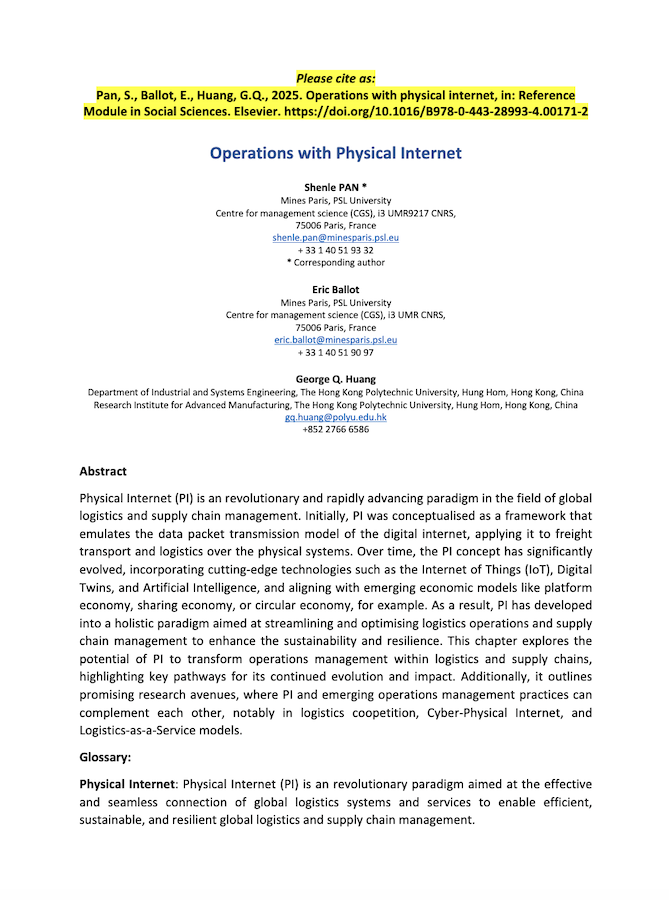
Operations with physical internet

  • Auteur/autrice de la publication :
  • Publication publiée :
  • Catégorie de la publication :

Physical Internet (PI) is an revolutionary and rapidly advancing paradigm in the field of global logistics and supply chain management. Initially, PI was conceptualized as a framework that emulates the data packet transmission model of the digital internet, applying it to freight transport and logistics over the physical systems. Over time, the PI concept has significantly evolved, incorporating cutting-edge technologies such as the Internet of Things (IoT), Digital Twins, and Artificial Intelligence, and aligning with emerging economic models like platform economy, sharing economy, or circular economy, for example. As a result, PI has developed into a holistic paradigm aimed at streamlining and optimizing logistics operations and supply chain management to enhance the sustainability and resilience. This chapter explores the potential of PI to transform operations management within logistics and supply chains, highlighting key pathways for its continued evolution and impact. Additionally, it outlines promising research avenues, where PI and emerging operations management practices can complement each other, notably in logistics coopetition, Cyber-Physical Internet, and Logistics-as-a-Service models.

Continuer la lectureOperations with physical internet

Integrated optimization and machine learning through hyperparameter selection: an application to predictive maintenance of wind turbines.

  • Auteur/autrice de la publication :
  • Publication publiée :
  • Catégorie de la publication :

This paper examines how optimization and machine learning can be combined to improve predictive maintenance in wind farms. Optimization integrated with machine learning creates powerful meth- ods to solve complex problems by improving solution search strate- gies and enhancing decision-making processes, in contrast with the usual sequential approach. This synergy enables algorithms to learn from data and guide optimization procedures more effectively. In this proposal, we present an application of this combination for predic- tive maintenance, where a MIP schedules tasks to minimize downtime while maximizing system reliability and machine learning models, in- cluding random forrest and isolation forrest, anticipate equipment fail- ures. The model we propose mobilizes ensemble learning with a loop such that the performance of the corresponding tasks planning allows to ad- just the threshold for aggregating the results of the different prediction models. The predictions are adjusted through iterations by the results of the optimization. The optimization then leads to a return to the en- semble learning, becoming similar to a layer of a learning algorithm. Experimentations were carried out on industrial data.

Continuer la lectureIntegrated optimization and machine learning through hyperparameter selection: an application to predictive maintenance of wind turbines.

Le changement climatique comme péril commun. Réconcilier action climatique et justice sociale

  • Auteur/autrice de la publication :
  • Publication publiée :
  • Catégorie de la publication :

Demonsant, C., Hatchuel, A., Levillain, K., & Segrestin, B. (Eds.). 2023. Le changement climatique comme péril commun. Réconcilier action climatique et justice sociale. Paris: Presses Des Mines. Equipe CGS

Continuer la lectureLe changement climatique comme péril commun. Réconcilier action climatique et justice sociale