Switching Perspectives: Enhancing Generative Artificial Intelligence’s Creativity, by Humans, With Design

  • Auteur/autrice de la publication :
  • Publication publiée :
  • Catégorie de la publication :

Over the past few years, with the advent of ChatGPT, generative artificial intelligence (GenAI) has been at the centre of numerous discussions regarding generative and creative power, especially with the hope that it will enhance human creativity and, consequently, transformative power. Creativity, especially human creativity, has long been studied, particularly by psychologists and design scientists, who have revealed the difficulty of overcoming the fixation effect. This effect can hinder creativity and has not yet been explored in relation to GenAI, even though it is of major importance for understanding creative issues. In this work, we propose leveraging the rich body of literature on design creativity and creativity management to shed light on the fixation effect related to GenAI tools, which are considered partners in the design process, and possible defixation techniques. To study this issue, we propose a twofold methodology: a first, in-depth qualitative step with design theory experts, leading to the formulation of hypotheses, and a second, experimental step based on the well-documented egg task in creativity to test the hypotheses. Ultimately, we show that the use of GenAI tools in creative endeavours results in a greater number of generated ideas and that it does not prevent the fixation effect but can foster idea exploration and thus help with second-order defixation. These results consequently show the importance of considering a cocreativity regime involving both humans and GenAI, and they extend knowledge on the fixation effect in this context. They also indicate the capacity of GenAI in creative processes, thus suggesting some relevant use cases to leverage these tools.

Continuer la lectureSwitching Perspectives: Enhancing Generative Artificial Intelligence’s Creativity, by Humans, With Design

Study of computer multi-instrumented reflexive conversation activity in preliminary architectural design

  • Auteur/autrice de la publication :
  • Publication publiée :
  • Catégorie de la publication :

The establishment of BIM raises issues at the transition between sketches, still mostly used in ideation, and project digital models. With the latest AI evolution, one way of supporting this transition is to provide sketch interpretation software generating digital representations. However, the question arises as to whether these two modes of representation can co-exist, and whether digital representations can provide a resource for designers in the preliminary phase. In this paper, we investigate the impact of auto-generated representations on the preliminary design activity of architects. We implement a Wizard of Oz protocol with nine participants sketching their design and being provided with CAD plans, 3D models and inspirational images. We study reflexive conversations by analyzing and categorizing behavior patterns preceding and following the reception of self-generated representations. We identify 23 patterns, and show the flexible role of the digital representations, having a strong impact on the process.

Continuer la lectureStudy of computer multi-instrumented reflexive conversation activity in preliminary architectural design

Jumping to conclusions: A visual comparative analysis of online debate platform layouts

  • Auteur/autrice de la publication :
  • Publication publiée :
  • Catégorie de la publication :

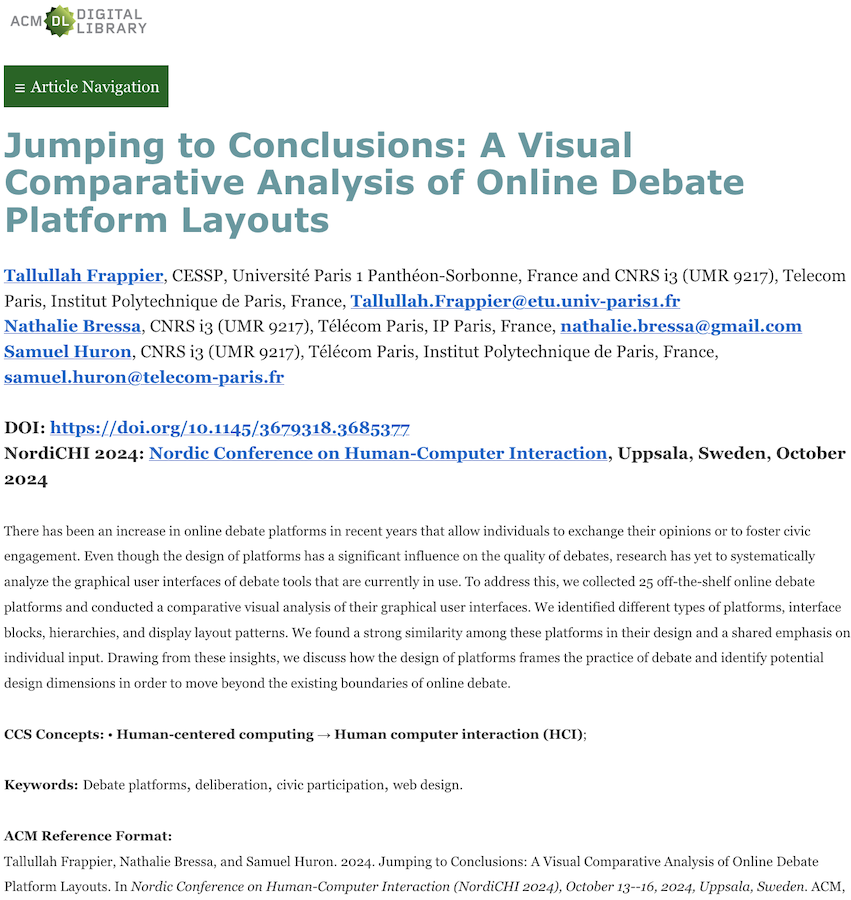
There has been an increase in online debate platforms in recent years that allow individuals to exchange their opinions or to foster civic engagement. Even though the design of platforms has a significant influence on the quality of debates, research has yet to systematically analyze the graphical user interfaces of debate tools that are currently in use. To address this, we collected 25 off-the-shelf online debate platforms and conducted a comparative visual analysis of their graphical user interfaces. We identified different types of platforms, interface blocks, hierarchies, and display layout patterns. We found a strong similarity among these platforms in their design and a shared emphasis on individual input. Drawing from these insights, we discuss how the design of platforms frames the practice of debate and identify potential design dimensions in order to move beyond the existing boundaries of online debate.

Continuer la lectureJumping to conclusions: A visual comparative analysis of online debate platform layouts

Making with Data: Physical Design and Craft in a Data-Driven World, A K Peters/CRC Press

  • Auteur/autrice de la publication :
  • Publication publiée :
  • Catégorie de la publication :

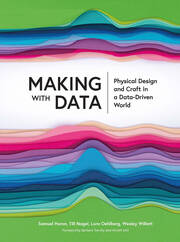
How can we give data physical form? And how might those creations change the ways we experience data and the stories it can tell? Making with Data: Physical Design and Craft in a Data-Driven World provides a snapshot of the diverse practices contemporary creators are using to produce objects, spaces, and experiences imbued with data. Across 25+ beautifully-illustrated chapters, international artists, designers, and scientists each explain the process of creating a specific data-driven piece—illustrating their practice with candid sketches, photos, and design artifacts from their own studios. The author website, featuring updates and more information about the projects behind the book, can be found here: https://makingwithdata.org/. Featuring influential voices in computer science, data science, graphic design, art, craft, and architecture, Making with Data is accessible and inspiring for enthusiasts and experts alike.

Continuer la lectureMaking with Data: Physical Design and Craft in a Data-Driven World, A K Peters/CRC Press

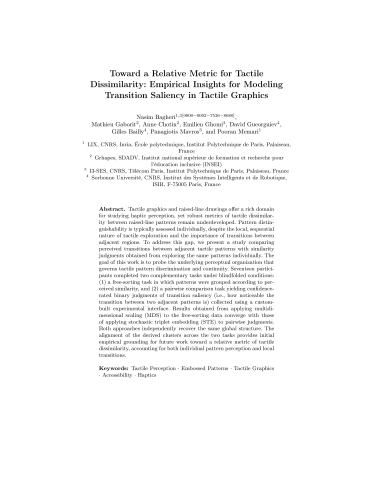
Toward a Relative Metric for Tactile Dissimilarity: Empirical Insights for Modeling Transition Saliency in Tactile Graphics

  • Auteur/autrice de la publication :
  • Publication publiée :
  • Catégorie de la publication :

Tactile graphics and raised-line drawings offer a rich domain for studying haptic perception, yet robust metrics of tactile dissimilarity between raised-line patterns remain underdeveloped. Pattern distinguishability is typically assessed individually, despite the local, sequential nature of tactile exploration and the importance of transitions between adjacent regions. To address this gap, we present a study comparing perceived transitions between adjacent tactile patterns with similarity judgments obtained from exploring the same patterns individually. The goal of this work is to probe the underlying perceptual organization that governs tactile pattern discrimination and continuity. Seventeen participants completed two complementary tasks under blindfolded conditions: (1) a free-sorting task in which patterns were grouped according to perceived similarity, and (2) a pairwise comparison task yielding confidence-rated binary judgments of transition saliency (i.e., how noticeable the transition between two adjacent patterns is) collected using a custom-built experimental interface. Results obtained from applying multidimensional scaling (MDS) to the free-sorting data converge with those of applying stochastic triplet embedding (STE) to pairwise judgments. Both approaches independently recover the same global structure. The alignment of the derived clusters across the two tasks provides initial empirical grounding for future work toward a relative metric of tactile dissimilarity, accounting for both individual pattern perception and local transitions.

Continuer la lectureToward a Relative Metric for Tactile Dissimilarity: Empirical Insights for Modeling Transition Saliency in Tactile Graphics

An automated multimodal framework for capturing dynamic and micro-scale interactions between the built environment and vulnerable older adults

  • Auteur/autrice de la publication :
  • Publication publiée :
  • Catégorie de la publication :

As global populations age, ensuring safe and independent mobility for older adults is a critical priority for urban planning and public health. Mobility in the built environment involves complex, moment-to-moment interactions, yet current assessment methods often rely on subjective surveys or static geospatial data that fail to capture dynamic human responses. Furthermore, these methods rarely address the specific needs of vulnerable individuals, such as those with knee osteoarthritis or a history of falls, who are most sensitive to environmental barriers. Hence, there is a lack of high-resolution, objective tools capable of quantifying how micro-scale built environmental features directly influence the physiological and kinematic states of these populations. Here we present an automated multimodal framework that integrates wearable motion sensors, physiological monitors, eye-tracking, and dual-perspective video to reconstruct a holistic profile of the walking experience. The framework employs SLAM and computer vision techniques to achieve precise tracking and environmental profiling. By synchronizing these inputs, the framework maps physiological and kinematic responses to specific built environment features. This overcomes the limitations of GNSS-denied settings and manual annotation, revealing micro-scale adaptations, including gait speed changes on slopes or during road crossings, that are often missed by conventional aggregate analyses. The resulting multimodal dataset captures the nuanced interplay between the built environment and vulnerable older adults. The computational pipelines and a specialized walkway surface material dataset are made publicly available. This work lays the foundation for large-scale, data-driven assessments of urban walkability, informing evidence-based design interventions to enhance safety and social engagement for aging societies.

Continuer la lectureAn automated multimodal framework for capturing dynamic and micro-scale interactions between the built environment and vulnerable older adults

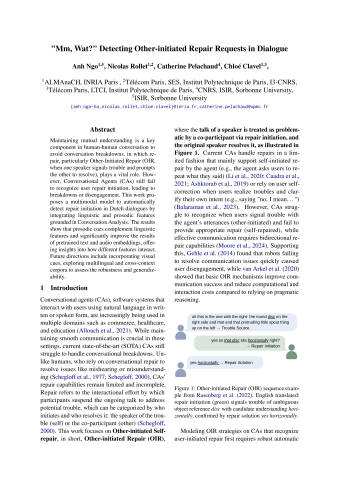
“Mm, Wat?” Detecting Other-initiated Repair Requests in Dialogue

  • Auteur/autrice de la publication :
  • Publication publiée :
  • Catégorie de la publication :

Maintaining mutual understanding is a key component in human-human conversation to avoid conversation breakdowns, in which repair, particularly Other-Initiated Repair (OIR, when one speaker signals trouble and prompts the other to resolve), plays a vital role. However, Conversational Agents (CAs) still fail to recognize user repair initiation, leading to breakdowns or disengagement. This work proposes a multimodal model to automatically detect repair initiation in Dutch dialogues by integrating linguistic and prosodic features grounded in Conversation Analysis. The results show that prosodic cues complement linguistic features and significantly improve the results of pretrained text and audio embeddings, offering insights into how different features interact. Future directions include incorporating visual cues, exploring multilingual and cross-context corpora to assess the robustness and generalizability.

Continuer la lecture“Mm, Wat?” Detecting Other-initiated Repair Requests in Dialogue

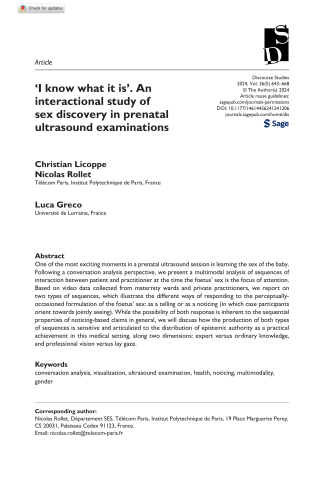
‘I know what it is’. An interactional study of sex discovery in prenatal ultrasound examinations

  • Auteur/autrice de la publication :
  • Publication publiée :
  • Catégorie de la publication :

One of the most exciting moments in a prenatal ultrasound session is learning the sex of the baby.Following a conversation analysis perspective, we present a multimodal analysis of sequences of interaction between patient and practitioner at the time the foetus’ sex is the focus of attention. Based on video data collected from maternity wards and private practitioners, we report on two types of sequences, which illustrate the different ways of responding to the perceptually-occasioned formulation of the foetus’ sex: as a telling or as a noticing (in which case participants orient towards jointly seeing). While the possibility of both response is inherent to the sequential properties of noticing-based claims in general, we will discuss how the production of both types of sequences is sensitive and articulated to the distribution of epistemic authority as a practical achievement in this medical setting, along two dimensions: expert versus ordinary knowledge, and professional vision versus lay gaze.

Continuer la lecture‘I know what it is’. An interactional study of sex discovery in prenatal ultrasound examinations