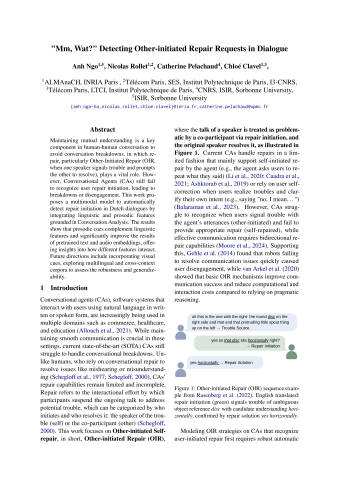
AI-Driven Behavioral Inference From Open Energy Data: Implications for Public Data Governance

  • Auteur/autrice de la publication :
  • Publication publiée :
  • Catégorie de la publication :

This paper shows that AI can leverage public and anonymized energy data to infer individual behaviors, including periods of presence or absence. It highlights the privacy risks associated with open data and calls for rethinking public data governance in light of emerging algorithmic capabilities.

Continuer la lectureAI-Driven Behavioral Inference From Open Energy Data: Implications for Public Data Governance

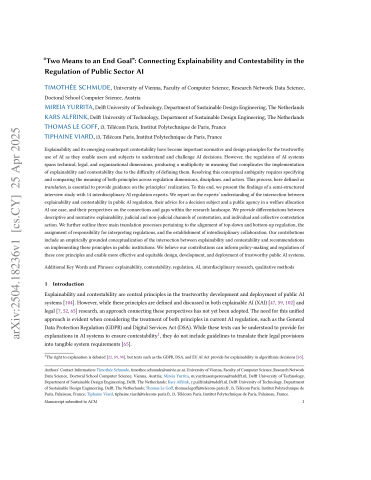
Two Means to an End Goal: Connecting Explainability and Contestability in the Regulation of Public Sector AI.

  • Auteur/autrice de la publication :
  • Publication publiée :
  • Catégorie de la publication :

Explainability and its emerging counterpart contestability are key normative and design principles for trustworthy AI, enabling users and subjects to understand and challenge AI decisions. Yet realizing these principles is difficult, as they take on different meanings across technical, legal, and organizational dimensions of AI regulation. To address this conceptual polysemy, we report findings from an interview study with 14 experts examining the intersection and implementation of explainability and contestability, and their interpretations in different research communities. We outline differentiations between descriptive and normative explainability, judicial and non-judicial channels of contestation, and individual and collective contestation action. We also identify key points of friction in realizing both principles, including alignment between top-down and bottom-up regulation, assignment of responsibility, and the need for interdisciplinary collaboration. Finally, we offer three AI policy recommendations to operationalize explainability and contestability through a Regulation-by-Design perspective. Our contributions inform policy research and regulation of these core principles, and support more effective and equitable design, development, and deployment of trustworthy public AI systems.

Continuer la lectureTwo Means to an End Goal: Connecting Explainability and Contestability in the Regulation of Public Sector AI.

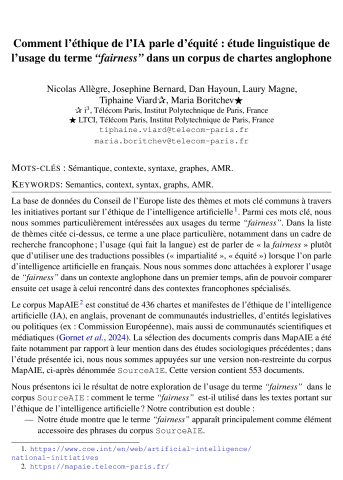
Comment l’éthique de l’IA parle d’équité: étude linguistique de l’usage du terme” fairness” dans un corpus de chartes anglophone

  • Auteur/autrice de la publication :
  • Publication publiée :
  • Catégorie de la publication :

La base de données du Conseil de l’Europe liste des thèmes et mots clé communs à travers les initiatives portant sur l’éthique de l’intelligence artificielle 1 . Parmi ces mots clé, nous nous sommes particulièrement intéressées aux usages du terme “fairness”. Dans la liste de thèmes citée ci-dessus, ce terme a une place particulière, notamment dans un cadre de recherche francophone; l’usage (qui fait la langue) est de parler de « la fairness » plutôt que d’utiliser une des traductions possibles (« impartialité », « équité ») lorsque l’on parle d’intelligence artificielle en français. Nous nous sommes donc attachées à explorer l’usage de “fairness” dans un contexte anglophone dans un premier temps, afin de pouvoir comparer ensuite cet usage à celui rencontré dans des contextes francophones spécialisés. Le corpus MapAIE2 est constitué de 436 chartes et manifestes de l’éthique de l’intelligence artificielle (IA), en anglais, provenant de communautés industrielles, d’entités legislatives ou politiques (ex : Commission Européenne), mais aussi de communautés scientifiques et médiatiques (Gornet et al., 2024). La sélection des documents compris dans MapAIE a été faite notamment par rapport à leur mention dans des études sociologiques précédentes ; dans l’étude présentée ici, nous nous sommes appuyées sur une version non-restreinte du corpus MapAIE, ci-après dénommée SourceAIE. Cette version contient 553 documents. Nous présentons ici le résultat de notre exploration de l’usage du terme “fairness” dans le corpus SourceAIE : comment le terme “fairness” est-il utilisé dans les textes portant sur l’éthique de l’intelligence artificielle ? Notre contribution est double : — Notre étude montre que le terme “fairness” apparaît principalement comme élément accessoire des phrases du corpus SourceAIE.

Continuer la lectureComment l’éthique de l’IA parle d’équité: étude linguistique de l’usage du terme” fairness” dans un corpus de chartes anglophone

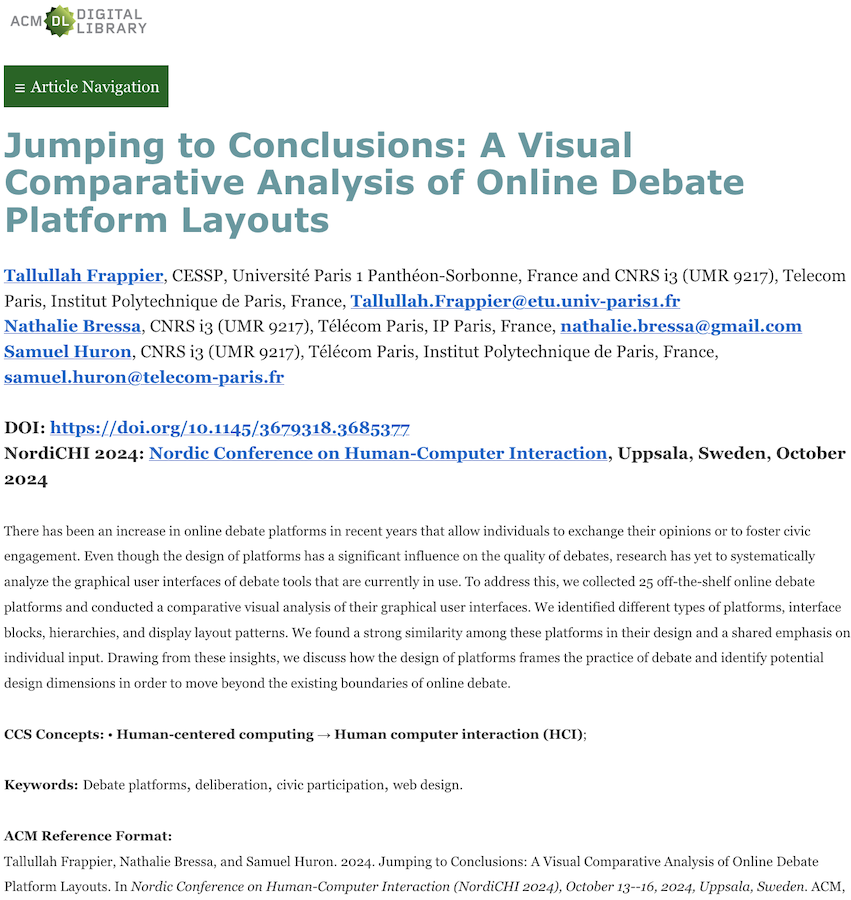
Jumping to conclusions: A visual comparative analysis of online debate platform layouts

  • Auteur/autrice de la publication :
  • Publication publiée :
  • Catégorie de la publication :

There has been an increase in online debate platforms in recent years that allow individuals to exchange their opinions or to foster civic engagement. Even though the design of platforms has a significant influence on the quality of debates, research has yet to systematically analyze the graphical user interfaces of debate tools that are currently in use. To address this, we collected 25 off-the-shelf online debate platforms and conducted a comparative visual analysis of their graphical user interfaces. We identified different types of platforms, interface blocks, hierarchies, and display layout patterns. We found a strong similarity among these platforms in their design and a shared emphasis on individual input. Drawing from these insights, we discuss how the design of platforms frames the practice of debate and identify potential design dimensions in order to move beyond the existing boundaries of online debate.

Continuer la lectureJumping to conclusions: A visual comparative analysis of online debate platform layouts

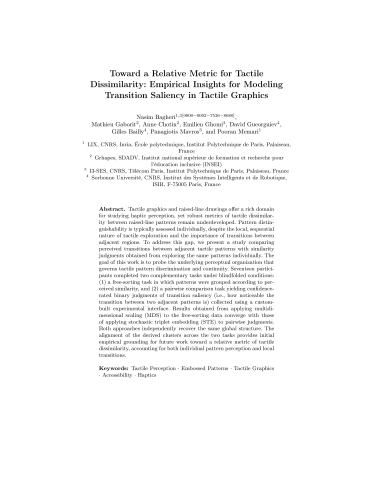
Toward a Relative Metric for Tactile Dissimilarity: Empirical Insights for Modeling Transition Saliency in Tactile Graphics

  • Auteur/autrice de la publication :
  • Publication publiée :
  • Catégorie de la publication :

Tactile graphics and raised-line drawings offer a rich domain for studying haptic perception, yet robust metrics of tactile dissimilarity between raised-line patterns remain underdeveloped. Pattern distinguishability is typically assessed individually, despite the local, sequential nature of tactile exploration and the importance of transitions between adjacent regions. To address this gap, we present a study comparing perceived transitions between adjacent tactile patterns with similarity judgments obtained from exploring the same patterns individually. The goal of this work is to probe the underlying perceptual organization that governs tactile pattern discrimination and continuity. Seventeen participants completed two complementary tasks under blindfolded conditions: (1) a free-sorting task in which patterns were grouped according to perceived similarity, and (2) a pairwise comparison task yielding confidence-rated binary judgments of transition saliency (i.e., how noticeable the transition between two adjacent patterns is) collected using a custom-built experimental interface. Results obtained from applying multidimensional scaling (MDS) to the free-sorting data converge with those of applying stochastic triplet embedding (STE) to pairwise judgments. Both approaches independently recover the same global structure. The alignment of the derived clusters across the two tasks provides initial empirical grounding for future work toward a relative metric of tactile dissimilarity, accounting for both individual pattern perception and local transitions.

Continuer la lectureToward a Relative Metric for Tactile Dissimilarity: Empirical Insights for Modeling Transition Saliency in Tactile Graphics

“Mm, Wat?” Detecting Other-initiated Repair Requests in Dialogue

  • Auteur/autrice de la publication :
  • Publication publiée :
  • Catégorie de la publication :

Maintaining mutual understanding is a key component in human-human conversation to avoid conversation breakdowns, in which repair, particularly Other-Initiated Repair (OIR, when one speaker signals trouble and prompts the other to resolve), plays a vital role. However, Conversational Agents (CAs) still fail to recognize user repair initiation, leading to breakdowns or disengagement. This work proposes a multimodal model to automatically detect repair initiation in Dutch dialogues by integrating linguistic and prosodic features grounded in Conversation Analysis. The results show that prosodic cues complement linguistic features and significantly improve the results of pretrained text and audio embeddings, offering insights into how different features interact. Future directions include incorporating visual cues, exploring multilingual and cross-context corpora to assess the robustness and generalizability.

Continuer la lecture“Mm, Wat?” Detecting Other-initiated Repair Requests in Dialogue

Heritage and urban development in Paris-Saclay: An inclusive temporal perspective for understanding territorial issues and dynamics

  • Auteur/autrice de la publication :
  • Publication publiée :
  • Catégorie de la publication :

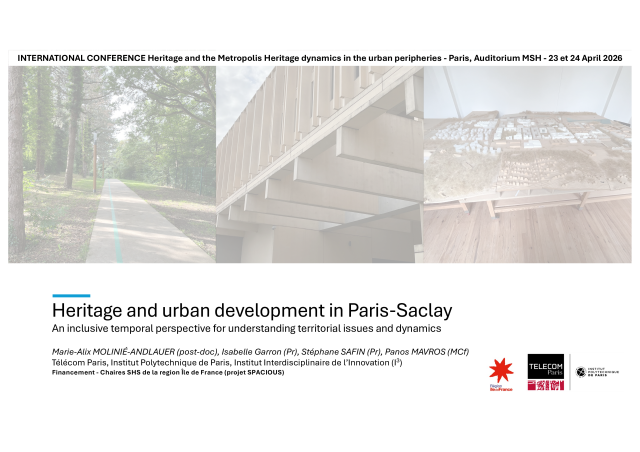
Molinié-Andlauer M.A., Garron, I. ,Safin, S, Mavros, P. (2026) Heritage and urban development in Paris-Saclay: An inclusive temporal perspective for understanding territorial issues and dynamics, INTERNATIONAL CONFERENCE: Heritage and the…

Continuer la lectureHeritage and urban development in Paris-Saclay: An inclusive temporal perspective for understanding territorial issues and dynamics

Integrated optimization and machine learning through hyperparameter selection: an application to predictive maintenance of wind turbines.

  • Auteur/autrice de la publication :
  • Publication publiée :
  • Catégorie de la publication :

This paper examines how optimization and machine learning can be combined to improve predictive maintenance in wind farms. Optimization integrated with machine learning creates powerful meth- ods to solve complex problems by improving solution search strate- gies and enhancing decision-making processes, in contrast with the usual sequential approach. This synergy enables algorithms to learn from data and guide optimization procedures more effectively. In this proposal, we present an application of this combination for predic- tive maintenance, where a MIP schedules tasks to minimize downtime while maximizing system reliability and machine learning models, in- cluding random forrest and isolation forrest, anticipate equipment fail- ures. The model we propose mobilizes ensemble learning with a loop such that the performance of the corresponding tasks planning allows to ad- just the threshold for aggregating the results of the different prediction models. The predictions are adjusted through iterations by the results of the optimization. The optimization then leads to a return to the en- semble learning, becoming similar to a layer of a learning algorithm. Experimentations were carried out on industrial data.

Continuer la lectureIntegrated optimization and machine learning through hyperparameter selection: an application to predictive maintenance of wind turbines.