
Carbon neutrality, the 1.5°C target, IAMs… These obscure terms are pervading journalistic debate and IPCC reports, without their actual meaning always being well understood. Sociologist, CNRS research fellow, and recipient of the CNRS Bronze Medal for her work on the IPCC, Béatrice Cointe wanted to offer points of reference to those interested in these questions. The result: Manuel des futurs climatiques, published on September 3 by Éditions Premier Parallèle, a work that is both instructive and accessible.
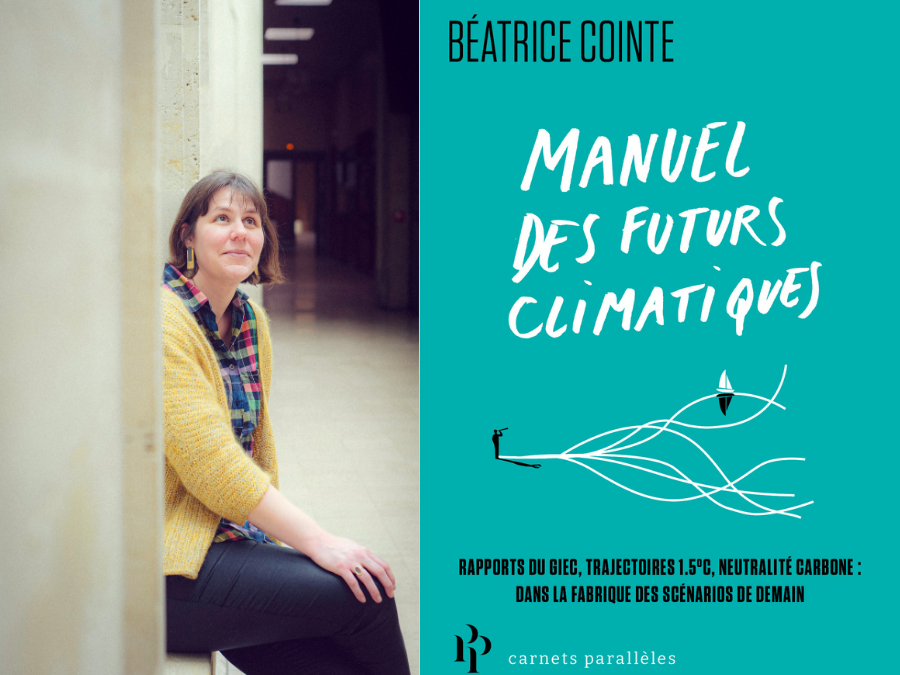
A book of climate terminology? Yes, but not only that — Béatrice Cointe takes us behind the scenes of the IPCC, a veritable scientific Tower of Babel, where researchers of diverse nationalities and cultures meet, their disciplines sometimes having nothing in common with one another. Already, in the background, one can sense the tensions between countries of the Global North and the Global South. “This group of researchers with highly heterogeneous specialties, though brought together under the common label of ‘climate science,’ is required to work together. These climate sciences in fact bring together specialists whose fields range from the study of plankton to building renovation, by way of the reconstruction of past climates,” the researcher explains.
What is the main working tool of these researchers? The central role of climate scenarios — devices that make it possible to harmonize assumptions about the future through models described by the researcher as “representations of the world,” says Béatrice Cointe, who followed their construction very closely. She also traces their unsuspected genealogy: the Club of Rome’s report The Limits to Growth, which brought together scientists and economists from 52 countries, and the International Institute for Applied Systems Analysis (IIASA), an unlikely site of scientific cooperation between the Eastern and Western blocs in the midst of the Cold War. From this history emerges a striking question: how did the planetary future become an object that we seek to map and steer?
The IPCC’s latest report, published in 2022, reported three thousand scenarios stemming from the multiplicity of data. “They are produced by highly complex numerical models, integrating energy, human and environmental systems: far from being mere academic outputs, they are tied to the way climate change has been constructed as a global, forward-looking, but also systemic problem — and it is this entanglement that I seek to untangle,” the researcher continues.
This diversity of models is not only far from neutral, but also carries within it the North-South antagonisms already perceptible within the IPCC. The example of COFFEE (COmpact Framework For Energy and the Environment) speaks for itself. This model belongs to the IAM (Integrated Assessment Models) family, digital tools that simulate the interactions between energy, economic and environmental systems in order to produce climate scenarios — a family of which COFFEE is one of the rare representatives designed by a country of the Global South. Each IAM bears the mark of the team that designed it. “COFFEE, designed to shed light on Brazil’s decarbonization, clearly shows how, in that country, energy, technology and agriculture are linked. And as a result, it brings to light a perspective that other models almost never question: the energy trajectories of countries in the Global North serve as a backdrop, a framework that goes unchallenged. Thus, the shift to biofuels, which plays a significant role in COFFEE’s energy mix, seems realistic to local engineers, whereas elsewhere it remains marginal,” the researcher continues.
Finally, economics also enters into the equation. Assessing and comparing the costs and benefits of climate action is, in a sense, at the heart of the work of climate economists, notably through a tool that appears innocuous: the discount rate. It is used to estimate, in today’s terms, the value of a future financial flow, based on the idea that a sum received immediately is worth more than the same sum received later. Liliana Doganova, a researcher at i3-CSI and author of Discounting the Future (Zone Books, 2024), describes this instrument as a genuine political technology: depending on the value assigned to it, it either favors or, on the contrary, penalizes the long-term investments needed for the climate transition — by minimizing the importance of future damage, or conversely by valuing responsibility toward future generations. Some calculations thus end up minimizing the cost of deforestation that would occur some fifty years from now, compared with the cost of shutting down an oil well. This raises a striking question as one reads this book: can the viability of the planet really be weighed against a financial cost?
Thus, beneath an appearance of technical neutrality, it is very real power struggles that play out within these scenarios. Even when the data are precise, a multitude of scenarios remains conceivable. And it is precisely because the range of climate futures is varied, contested and never neutral that Manuel des futurs climatiques invites us to decode this interplay of tensions, between science, diplomacy and economics.
Premier Parallèle© Sylvain Golvet © Littopia