Séminaire Polytechnique Santé #13
Comment construire des entreprises européennes leaders de la santé numérique ?

Comment construire des entreprises européennes leaders de la santé numérique ?
Le dogme de l’innovation intensive se heurte désormais aux dégradations croissantes que cette course engendre sur l’environnement naturel, l’obsolescence des compétences et à la perte de sens pour les salariés. Il faut donc innover autrement et repenser l’innovation en intégrant les impacts sociétaux. Mais pourquoi et comment faire ? L’objectif de cet article est de proposer un agenda de recherche pour les sciences de gestion pour refonder la gestion des innovations à impact. En premier lieu, il s’agit de comprendre comment l’innovation est aujourd’hui cadrée, les impensés que ce cadrage produit et les impacts indésirables provoqués. En deuxième lieu, temps, il s’agit d’étudier et théoriser les pratiques d’innovation responsables à impact dans leur diversité, tout en proposant un cadre intégrateur. Enfin, en troisième lieu, nous esquissons des pistes pour changer les cadres cognitifs de l’innovation à impact, à savoir adopter une responsabilité projective, repenser l’instrumentation gestionnaire et mettre en cohérence les politiques publiques.

Séance intitulée « Vers une bureaucratie qui prend soin (caring bureaucracy) ? Le cas suisse de l’Ensemble Hospitalier de la Côte » avec Nathalie Divorne, Anne-Sophie Dubey, Camille Toussaint.
Numerous resistance or contestation movements exhibit a surprising ability to bring together individuals with very different sensibilities and arguments that may be contradictory. Rooted in a study of a resistance movement against 5G technology, this article helps to better understand the phenomenon whereby multiple and heterogeneous resistances come together within the same movement by showing the role played by rhetoric. We analyse the great diversity of arguments in 5G resistance, focussing on four main lines that structure the arguments, and we shed light on an ‘argument decentring’ phenomenon where, although they may not adopt the arguments advanced by other opponents, some actors leverage the resulting controversy to legitimate their own discourse and increase the credibility of their own lines of argumentation. By considering rhetoric as a mechanism that aggregates resistance movements, this study contributes to a better understanding of the mechanisms and effects of argument heterogeneity, in particular online or on social media.

Based on a detailed examination of video recordings of Locomotion and Orientation lessons, this chapter explores the social production and reception of assistance proposals to blind students by sighted pedestrians at an urban crossing. We examine the combination of several resources which makes publicly recognizable an embodied and embedded display of trouble (Kendricks and Drew, 2016). We show how passer-byes approach the blind person and introduce a confirmation query (“you want to cross?”), which is then systematically rejected by a blind student’s account (“I am learning locomotion right now”). This rejection reveals an another, contrastive setting with its alternate set of relevancies, sequential organization and categories. In this second context, the various attempts of passer-by to initiate help proposals become accountable interruptions of an ongoing exercise. We will show how the normative features of the visual order in which the blind student is immersed disturbs his attempts to turn into practice a set of alternatives, audible-based methods for crossing streets, without stopping him to cope with the normative consequences of the practical management of two contrastive settings. The very apprenticeship of a new alternative set of sensorial abilities bumps into the taken for granted visual practices which shape the common production and understandings of urban orders and disabilities.
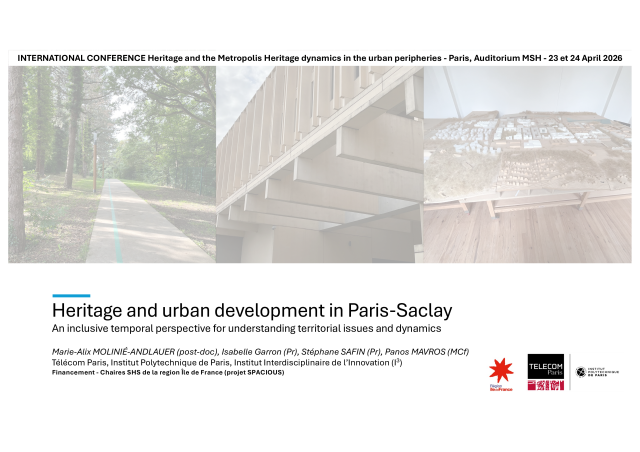
Molinié-Andlauer M.A., Garron, I. ,Safin, S, Mavros, P. (2026) Heritage and urban development in Paris-Saclay: An inclusive temporal perspective for understanding territorial issues and dynamics, INTERNATIONAL CONFERENCE: Heritage and the…
This paper is intended as a contribution to the social science literature on Patient Advocacy Groups (PAGs). It examines the recent emergence and development of cancer patient organizations that self-define as “oncogene-focused,” that is, as centered on tumor-driving genetic mutations that offer novel therapeutic opportunities for tumors to be targeted by precision drugs. Drawing on qualitative methods including interviews with representatives of oncogene focused PAGs, analysis of the groups’ publications (biomedical journals, eNewsletters), websites, and social media activity, the paper explores the characteristics of these PAGs’ forms of activism. It shows that their common denominator is a focus on patient survival. This shared goal translates into a form of activism that centers on therapeutic actionability, that is, a set of initiatives aiming at the articulation of research, clinical trials, and care to improve the patients’ quality of life and maximize survival thanks to awareness of and access to the latest therapies. Beyond individual differences between PAGs, we observe the increasingly seamless entanglement of their activities. Their mutually supportive interventions result in the establishment of an ecosystemic form of activism that also succeeds in mobilizing clinicians and researchers at the increasingly porous interface between research and care.
In an increasing number of countries, mainly but not restrictively in the global North, the combination of infrastructures’ degradation, budgetary constraints and rising environmental issues has gradually shifted professional and public concerns from extension to upkeep. This constitutes the crystallisation of a specific configuration of infrastructure management, which the authors propose to term an “age of infrastructure maintenance” and which contrasts dramatically with the modern infrastructural ideal. Focussing on French water network management, this paper draws on an 18-month in-depth institutional ethnography to investigate what this age of maintenance concretely encompasses. It shows that in France, and in Europe, such an age rests on a reproblematisation of maintenance, whose scope is reframed in a “more-than-corrective” perspective. This leads to a practical and ontological reconsideration of infrastructures, which is illustrated by three main transformations: infrastructures are rediscovered through proximal enquiries, they are carefully monitored as living entities, and they are put at the centre of new valuation processes. This specific moment of infrastructure maintenance appears to be generative, opening up multifaceted transformations that pave the way for a less modernist and industrial vision of infrastructure management.
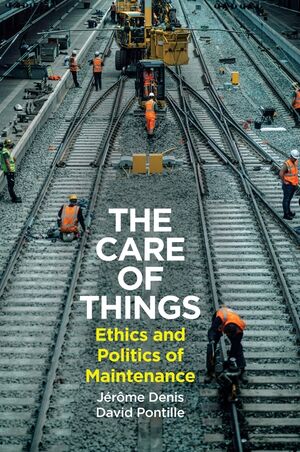
What does a coffee machine, a car, road signs, a smartphone, a cathedral, a work of art, a satellite, a bicycle, a washing machine, a bridge, a watch, a computer, the body of a prominent politician and a tractor have in common? Pretty much nothing – except for the fact that, no matter how small, large, important or insignificant something is, it rarely survives without being cared for. Every object eventually experiences wear and tear, it deteriorates, stops working or breaks down. But are we giving the care of things the recognition it deserves? A counterpoint to our modern obsession with innovation but less striking than the one-off act of restoration, the delicate act of making things last rarely attracts our attention. This book disrupts our dominant narratives by putting those individuals skilled in the art of maintenance front and centre. Jérôme Denis and David Pontille shine a spotlight on the subtle aspects of caring for things, tracing the stories of those involved and, with them, the ethical challenges raised and political lessons learned. These people demonstrate a sensitivity and attentiveness to fragility; they encourage us to cultivate a material diplomacy in which wear is accepted and our relation to things becomes a matter of negotiation and compromise – a far cry from the frenetic rhythm of planned obsolescence inherent in hyper-consumerism. Maintenance demarcates the contours of a world in which we have relinquished the human longing for unlimited power and technological autonomy, a world where our attachment to things is more profound than we ever imagined.
Although graffiti writing has been the object of numerous analyses for fifty years, the entangled practices of graffiti writers and buffers’ interventions remain understudied. By considering their actual gestures in front of urban surfaces, this text emphasizes the similarities of practices usually seen as antagonistic. Drawing on Deleuze’s masterful work about repetition and difference, it notably points out the sensitive, attentional, and technical common features of graffiti writers and buffers, the choreographic dynamics at the core of their performances, and the layered material rhythm resulting from their intertwined actions. Whether they take the form of a soothed dialogue moved by a shared experience, a trench warfare in performances, or an intense unintended collaboration, the relationships between graffiti writers and buffers appear to be driven by the transformative principle of repetition.